

|
Impending Global Depression? December 24, 2007 |
Crisis may make 1929 look a 'walk in the park'Last Updated: 11:02pm GMT 23/12/2007 As central banks continue to splash their cash over the system, so far to little effect, Ambrose Evans-Pritchard argues things are rapidly spiralling out of their control Twenty billion dollars here, $20bn there, and a lush half-trillion from the European Central Bank at give-away rates for Christmas. Buckets of liquidity are being splashed over the As the credit paralysis stretches through its fifth month, a chorus of economists has begun to warn that the world's central banks are fighting the wrong war, and perhaps risk a policy error of epochal proportions.
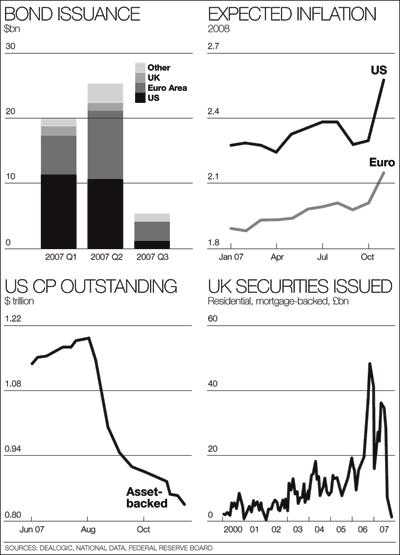
"Liquidity doesn't do anything in this situation," says Anna Schwartz, the doyenne of "It cannot deal with the underlying fear that lots of firms are going bankrupt. The banks and the hedge funds have not fully acknowledged who is in trouble. That is the critical issue," she adds. Lenders are hoarding the cash, shunning peers as if all were sub-prime lepers. Spreads on three-month Euribor and Libor - the interbank rates used to price contracts and Club Med mortgages - are stuck at 80 basis points even after the latest blitz. The monetary screw has tightened by default. "The central banks are rapidly losing control. By not cutting interest rates nearly far enough or fast enough, they are allowing the money markets to dictate policy. We are long past worrying about moral hazard," he says. "They still have another couple of months before this starts imploding. Things are very unstable and can move incredibly fast. I don't think the central banks are going to make a major policy error, but if they do, this could make 1929 look like a walk in the park," he adds. The Bank of England knows the risk. Markets director Paul Tucker says the crisis has moved beyond the collapse of mortgage securities, and is now eating into the bedrock of banking capital. "We must try to avoid the vicious circle in which tighter liquidity conditions, lower asset values, impaired capital resources, reduced credit supply, and slower aggregate demand feed back on each other," he says. Quietly, insiders are perusing an obscure paper by Fed staffers David Small and Jim Clouse. It explores what can be done under the Federal Reserve Act when all else fails. Section 13 (3) allows the Fed to take emergency action when banks become "unwilling or very reluctant to provide credit". A vote by five governors can - in "exigent circumstances" - authorise the bank to lend money to anybody, and take upon itself the credit risk. This clause has not been evoked since the Slump. Yet still the central banks shrink from seriously grasping the rate-cut nettle. Understandably so. They are caught between the Scylla of the debt crunch and the Charybdis of inflation. It is not yet certain which is the more powerful force. This has eerie echoes of In theory, When a credit system implodes, it can feed on itself with lightning speed. Current rates in Bernard Connolly, global strategist at Banque AIG, said the Fed and allies had scripted a Greek tragedy by under-pricing credit long ago and seem paralysed as post-bubble chickens now come home to roost. "The central banks are trying to dissociate financial problems from the real economy. They are pushing the world nearer and nearer to the edge of depression. We hope they will eventually be dragged kicking and screaming to do enough, but time is running out," he said. Glance at the more or less healthy stock markets in Glance at the debt markets and you hear a different tale. Not a single junk bond has been issued in "The kind of upheaval observed in the international money markets over the past few months has never been witnessed in history," says Thomas Jordan, a Swiss central bank governor. "The sub-prime mortgage crisis hit a vital nerve of the international financial system," he says. The market for asset-backed commercial paper - where Professor Spencer says capital ratios have fallen far below the 8 per cent minimum under Tim Congdon, a banking historian at the London School of Economics, said the rot had seeped through the foundations of British lending. Average equity capital has fallen to 3.2 per cent (nearer 2.5 per cent sans "goodwill"), compared with 5 per cent seven years ago. "How on earth did the Financial Services Authority let this happen?" he asks. Worse, changes pushed through by Gordon Brown in 1998 have caused the de facto cash and liquid assets ratio to collapse from post-war levels above 30 per cent to near zero. "Brown hadn't got a clue what he was doing," he says. The risk for
In With Brünhilde fuming about Brot prices, the ECB has to watch its step. Frankfurt cannot easily cut rates to cushion the blow as housing bubbles pop across southern The ECB's little secret is that it must never allow a Northern Rock failure in the eurozone because this would expose the reality that there is no EU treasury and no EU lender of last resort behind the system. Would German taxpayers foot the bill for a Spanish bail-out in the way that Kentish men and maids must foot the bill for Citigroup, Merrill Lynch, UBS, HSBC and others have stepped forward to reveal their losses. At some point, enough of the dirty linen will be on the line to let markets discern the shape of the debacle. We are not there yet. Goldman Sachs caused shock last month when it predicted that total crunch losses would reach $500bn, leading to a $2 trillion contraction in lending as bank multiples kick into reverse. This already seems humdrum. "Our counterparties are telling us that losses may reach $700bn," says Rob McAdie, head of credit at Barclays Capital. Where will it end? The big banks face a further $200bn of defaults in commercial property. On it goes. The International Monetary Fund still predicts blistering global growth of 5 per cent next year. If so, markets should roar back to life in January, as though the crunch were but a nightmare. There again, the credit soufflé may be hard to raise a second time. ___________________________________________________KNOWLEDGE@WHARTONWhen world powers invest like hedge fundshttp://www.delawareonline.com/apps/pbcs.dll/article?AID=/20071224/BUSINESS/712240318/1003/BUSINESS When the The same response followed the early December news that UBS was selling a 10.8-percent share to the government of But is foreign ownership -- or, more precisely, foreign government ownership -- really a good thing? Many experts think this mushrooming trend bears watching, especially for any sign that these funds are evolving from pure investment vehicles into tools for exerting political pressure on the "target" countries. "I think pressure is a legitimate worry, but I'm not sure we have seen signs of that yet," says Wharton finance professor Franklin Allen. There is nothing intrinsically wrong with foreign ownership, suggests Wharton finance professor Richard Marston, but ownership by foreign governments could be different from ownership by foreign businesses. "Clearly, there are industries where we would be concerned about certain countries having an ownership interest," he says, citing airlines and military contractors. "You do worry that these are governments, and you worry about their motivation." Governments, through investment pools known as sovereign wealth funds, have put tens of billions of dollars into Western financial firms this year, from Bear Stearns and Barclays to HSBC Holdings and Blackstone Group, investing at bargain prices amid the subprime crisis. Two Middle Eastern government funds now even own a third of the London Stock Exchange. None of this investment has drawn the kind of outrage that greeted a 2006 plan for a government-owned business in the Concerns over secrecy Still, some politicians and economists are concerned about the growing power of sovereign wealth funds, most of which are based in the Middle East and While cross-border investments are nothing new, the sovereign funds raise special questions because the investment decisions are controlled by governments rather than individuals or corporations. And, unlike central banks, which tend to invest reserves in assets like U.S. Treasury bonds, the sovereign funds often invest in corporations. This year, the largest target country for such investment has been the The 20 largest sovereign wealth funds, each worth more than $10 billion, are estimated to control more than $2 trillion in assets, overshadowing the $1.5 trillion thought to be managed by hedge funds, which have been subject to calls for greater regulation because of their market clout. Like hedge funds, most sovereign funds are secretive. There is no comprehensive list of what they own, nor any mandatory reporting of their investment policies. The Abu Dhabi Investment Authority, established in 1976, is the largest sovereign fund, with assets estimated at $500 billion to $875 billion, according to a widely cited analysis last August by Edwin M. Truman, senior fellow at the Peterson Institute for International Economics in Though the funds are typically found in countries with big trade surpluses, there is one in the U.S: the state-run Alaska Permanent Fund, founded in 1976 to reinvest oil profits. The oldest major fund, Reinvesting oil profits, for now Most of the sovereign funds that are soaring in size have rising oil prices to thank. In fact, it's no coincidence that the biggest funds belong to oil-producing states, which are using the funds to reinvest oil profits so there will be new sources of income when the oil is gone, Marston notes, adding that Countries that build up foreign-exchange reserves typically invest them in liquid assets like U.S. Treasuries. But once reserves are big enough to cover any short-term needs like currency intervention, countries feel they can afford to tie money up on long-term investments that offer better returns, says Wharton finance professor Richard J. Herring. "If you have your liquidity needs taken care of, then you start thinking about making longer-term investments. It's a very natural thing." Since sovereign funds have traditionally taken a long-term approach to investing, they have had a stabilizing influence on world financial markets, Herring says. But because the top 20 sovereign funds are so large, they do put a lot of concentrated economic power under the control of a small number of people, often in autocratic countries. The smaller sum controlled by hedge funds is divided among thousands of players. Writing in the Financial Times last July, former U.S. Treasury Secretary and Harvard president Lawrence Summers noted that government shareholders may not always have the same interests as ordinary shareholders. "The logic of the capitalist system depends on shareholders causing companies to act so as to maximize the value of their shares," he wrote. "It is far from obvious that this will over time be the only motivation of governments as shareholders. They may want to see their national companies compete effectively, or to extract technology or to achieve influence." Governments of target, or "host" countries, could find themselves in awkward situations, he said. "What about the day when a country joins some 'coalition of the willing' and asks the So far, there have not been any serious cases of this power being used for political or other non-investment purposes. One of the few examples is relatively mild: In June 2006, the Norwegian fund sold its more than $400 million in Wal-Mart holdings, criticizing the way the company treated its workers. Still, the temptation to use financial clout to further non-financial goals is ever-present, Herring says, recalling that many American universities and pension funds divested themselves in the 1980s of companies doing business in An inside look at Western companies According to Herring, the sovereign funds' investments in financial-services firms may be motivated not just by hopes of good investment returns, but by the desire to learn how those Western companies operate. In addition to the recent deals, Even so, he adds, that's no cause for alarm, as the For many observers, the biggest concern is not the potential for political shenanigans but uncertainty about how sovereign funds might affect the markets. In an article this fall in Finance & Development, a quarterly publication of the International Monetary Fund, IMF research director Simon Johnson noted that "unfortunately, there's a lot we don't know about sovereign funds. Very few of them publish information about their assets, liabilities or investment strategies." If the funds emphasize a buy-and-hold strategy, as is widely thought, they help stabilize markets, he said. At the same time, he cited some anecdotal evidence of sovereign funds investing in other funds, such as hedge funds, that multiply their impact through borrowing. Leveraging can destabilize markets when bets go wrong. The global value of traded securities is about $165 trillion, so $3 trillion in sovereign funds is not yet a major concern, he wrote. But if the figure rises to $10 trillion, and if many funds do employ leverage, the funds will bear watching, he added. The Peterson Institute's Truman advocates "a quantum increase in transparency and accountability" for sovereign funds. At a minimum, he says, the funds should publish annual reports detailing investment strategies and holdings. This fall, the U.S. Treasury Department called on the IMF and World Bank to develop a "best practices" guideline for sovereign funds. Allen, Herring and Marston agree that greater transparency would be good. But Herring notes that such requirements would not be easy to impose: "It's hard to see how you get compliance with so-called 'voluntary' guidelines when the people who are making the investment decisions are really not involved in putting together the guidelines." Harper Rejects Debt Bailout, Putting Pressure on By Theophilos Argitis and David Scanlan Dec. 21 (Bloomberg) -- Canadian investors holding $33 billion in short-term debt that plunged in value will have to rely on commercial banks for support after Prime Minister Stephen Harper said he won't bail them out. ``If the government became the day-to-day underwriter of market risk in commercial securities markets, that's a bottomless pit,'' Harper said in an interview in Harper's refusal to shore up the market for asset-backed commercial paper -- 30- to 90-day securities backed by car loans, credit card debts and mortgages -- leaves holders at the mercy of the country's biggest banks. Some banks have already expressed reluctance to provide support and are resisting pressure from the central bank. ``If the Canadian chartered banks don't go along with what they are apparently being promoted to do by the Bank of Canada, then what? Then we have a potential financial and economic problem,'' said Dale Orr, managing director of Canadian research in The Canadian commercial-paper crisis comes as the nation's economy is weakening. Harper said he's worried that a U.S. slowdown will exacerbate matters, leaving little room to stimulate the economy with spending or tax cuts in his next annual budget proposal, due in February or March. Market Freeze ``I don't think politicians, certainly not in Canada, have fully grasped the severity of what is going on,'' said Hans Black, chairman of Interinvest Consulting Corp. in Montreal, which manages about $2.8 billion. ``We are at a very serious juncture, and there's a serious risk of unraveling.'' Harper, 48, said commercial-paper buyers must accept responsibility for their investments. Holders of the debt, which may be worth as little as 50 percent of face value, include Caisse de Depot et Placement du Quebec, Canada's biggest pension-fund manager, Barrick Gold Corp. and Baffinland Iron Mines Corp. ``When people undertake commercial transactions, they have to be prepared to assess and evaluate risks,'' Harper said on Dec. 18, sitting on a living room lounge chair in his residence overlooking the Ottawa River. Flaherty, Dodge Helping An investors' group led by ``This government has been, through its agencies and arms such as the Bank of Canada, fully apprised of all the discussions,'' Harper said. ``It would be very unlikely for a Conservative government to become the backer of commercial paper. That would run pretty strongly against our overall market-oriented economic policy.'' Less Fiscal Room Harper, whose Conservative Party government may face voters in 2008, also said he expects a ``stand-pat fiscal policy'' next year, as the slumping ``It's impossible to see how that doesn't affect this country in some way,'' Harper said. ``As we approach our budget, we will not be suddenly proclaiming oodles of fiscal room.'' That means the budget won't include ``long-term spending measures'' or big tax cuts, he said. Delivering the capital- gains tax break he promised in his 2005-06 campaign also is ``unlikely'' next year, Harper said. ``We will be doing what households and businesses do when things are uncertain: We will be acting in a stable and cautious manner and we will be focusing on paying down the debt,'' he said. Cutting Forecasts The Finance Department cut its 2008 growth forecast to 2.4 percent from 2.9 percent, and the central bank cut interest rates for the first time in more than three years on Dec. 4. ``We did all of our major tax initiatives early to secure domestic demand and create a good long-term business climate,'' Harper said. In another matter, Harper wouldn't rule out selling all or part of state-owned Atomic Energy of Canada Ltd., which makes radioactive material for cancer screenings. A safety-related shutdown of its reactor from Nov. 18 until Dec. 16 caused cancer-treatment delays in To contact the reporters on this story: Theophilos Argitis in Last Updated: December 21, 2007 00:13 EST
|