

|
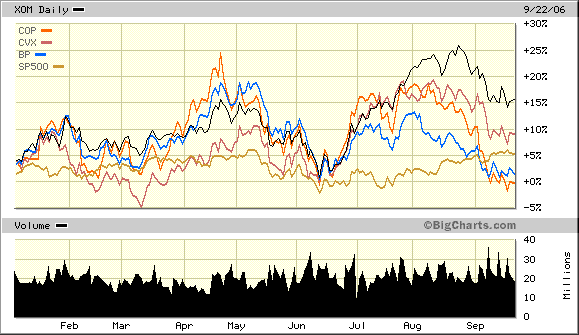
The article below shows perhaps the beginning of exposure of excesses of the Hedge Fund industry. Amaranth's collapse may be the tip of the iceberg as the following article claims. More importantly, though, American Households have perhaps punished tacitly the bad gamblers who have orchestrated trading strategies to transfer wealth from the multitude to a few. The multitude may have meted punishment to the gamblers by cutting consumption of oil through strategies like commuting to work through mass transit and by cutting unnecessary travels. This is a remarkable response towards gambles. But it is not sufficient to erase the usurious credits generated by of few (mostly hedge fund holders) and held as indebtedness on the rest of society. Will the losses in the Hedge Fund industry usher in the second Global Great Depression? Well, the yield curve has dramatically reversed with the 10-year rate at 4.6% while the Federal Reserve's decreed one-year rate stays at 5.25%. Will the American economy lead to a Japanese style zero nominal rate of interest? If this happens, it may wipe out any excessive usuriously generated credits from the system, naturally, without government intervention. More on this is in: Prosperity: Optimal Governance, Banking, Capital Markets, Global Trade, and Exchange Rate. Sankarshan Acharya Citizens for Development and Pro-Prosperity.Com SeekingAlpha http://biz.yahoo.com/seekingalpha/060924/17391_id.html?.v=1&printer=1 Phil Davis submits: Amaranth lives! Quote of the day: “We lost a lot of our own money this month, we lost more of your money. We feel bad about losing our own money. We feel worse about losing your money.” Only the money that was “their own” used to be yours too as the fund charged fees of 1.4% of the assets ($126M) plus 20% of the profits against the $9b dollar fund. But wait, there’s more... According to Business Week: "In 2003, for instance, Amaranth Advisors of Greenwich, Conn., logged charges on its Amaranth Partners fund of about 1.4% of net assets for "bonus compensation to designated traders" and about 2.3% for "operating expenses." Although Amaranth does not have a traditional management fee, the filing reveals that when an investor's account shows a net profit over the previous 12 months, the manager is entitled to a "management allocation of income" of up to 1.5% of each member's account balance per year. The manager also receives a 20% cut of each investor's net profits. This 20% is reduced by the amount paid to the traders, as well as by the amount of the operating expenses. If the fund is losing money, investors remain on the hook -- certainly for the operating expenses and possibly for any trader bonuses, too. Amaranth declined to comment.” I think a hedge fund should be run more like a corporation. My 1.5% should be a salary, perhaps another .5% for expenses, and the rest is paid out in stock bonuses which I can only redeem 1:1 with my shareholders. So when I make 20%, for the fund, you make 16% and I hold 4% in restricted stock. When I lose 20% for the fund, I lose 20% of my stock right along with you. When I overspend on a Christmas party, 20% of that money is mine too! Think that would make me think twice about betting half the assets on red? Another domino that may suffer some fallout from the Amaranth scandal is the ICE, where many hedge funds trade. As I mentioned at the beginning of the month, the unregulated trading that runs rampant at this " Dominoes lined up to date include (according to NYTimes DealBook): Morgan Stanley (NYSE: MS - News), Goldman Sachs Group Inc. (NYSE: GS - News), Credit Suisse Group (NYSE: CSR - News) and Deutsche Bank AG (NYSE: DB - News), who had direct investments in Amaranth, as well as Citigroup Inc. (NYSE: C - News) (who are rumored to be attempting to take over what’s left of the fund), JPMorgan & Chase Co. (NYSE: JPM - News), and Citadel. If you think this is over -– you must read this. Really, you must! I usually quote things, but Heather Timmons is my new journalistic hero for coming up with an article where I want to quote 75% of the lines! So really, go read this – I’ll wait... OK just a couple of major points: “Traders in the natural gas market referred to Mr. Hunter of Amaranth as a “bully,’’ not in reference to his personality but to his ability to move the price of natural gas artificially, because of the huge positions he was taking.” So when I say “they” are manipulating the markets -– now we’ve got one name! “What younger traders often lack is a strategy to unwind their trades if the market goes against them.” “Still, energy trading will always entail “significant risk," he said, “because storage and transportation are limited and demand is stochastic and highly inelastic." “When the market retreats, it is vicious.” My only criticism is that the $60b estimate of money invested in energy by hedge funds is clearly a gross understatement as there are 7,000 funds and just one, Amaranth lost a $6b bet in natural gas alone! You can toss and turn all night, but you still can’t worry enough to cover this potential disaster. First of all, understand that Amaranth tried to cover up their losses, doubled down, lost and doubled down again and lost. Even as recently as Wednesday, the fund was claiming that they “only” lost 35% of their assets when, in fact, it was closer to 65% of what they reported on-hand as of 8/31. Worse than that (yes it is worse), CNBC and most of the financial press is clinging to a fantasy that there are “winners and losers” in these trades so it all balances out in the great game of market Karma, and they are telling you there will be limited overall impact. Not true, not true, NOT TRUE! Yes there are winners, but they’re probably no one you know. How does oil get to $70 in the first place? 1) You poke a stick in the ground and oil pops out. This tends to cost $8-$20 a barrel. Let’s call it a worst-case $20. 2) It is then priced on the open market which is driven by speculators who take a premium to guarantee delivery on a certain date, a form of insurance. While those speculators do buy and sell to each other (the zero-sum game), their actions inch (or recently yard) up the price paid to the producers. Just like us options traders, we may jack up the price of a stock with frenzied buying and selling, but all we trade are contracts to buy the stock; the actual stocks are purchased by other people. 3) The producer is paid the spot price, the price at which the speculators generally settle on, of $65 a barrel or $1.54 per gallon. The money is exchanged for black liquid and leaves the country (trade deficit) FOR GOOD!!! When the price of oil goes down, they don’t load up tankers with $100 bills to send your money back! I was going to get into refining distribution tax etc., but I don’t want to cloud the issue. You work to make money which you give to the gas station guy, who gives it to the refiner, who gives it to the tanker company, who gives it to the producer. That money, about 60% of the cost of each gallon of gas, NEVER COMES BACK, EVER! So when a bunch of out-of-control traders drive the cost of a barrel of oil from $25 to $65 – it constitutes an extra $189,000,000,000 a year that goes from you to OPEC and other non-US producers. When it turns out that those traders overpaid for 3 months worth of oil by $20 a barrel, that’s $23b that isn’t coming back anywhere, it just goes up in smoke as the prices fall. Very, very simply: The trader paid $77 for a barrel of oil and sent the cash (the cash that Amaranth feels very bad about losing) to Saudi Arabia in exchange for a barrel of oil. Now he finds that he can only sell it for $60. That is a real, actual, irreversible (because someone is going to consume it) loss of $17. There is no “winner” on the other side of the trade; just a nation full of suckers (oops -- I meant to say voters) who let things get so out of hand. Sounds a lot like the Savings-and-Loan scandal doesn’t it? The S&L scandal was also caused by changes in regulations allowing out of control brokers (that time it was mortgage and loan brokers) to run wild, lending to their pals and overcharging U.S. citizens hundreds of billions in order to pocket tens of billions in commissions for themselves. The S&L scandal started out with one, then another institution being on the wrong side of interest and real estate bets, which snowballed as webs of interconnected institutions began falling-in upon each other. The actual crisis played out over years and was originally expected to be a $10-$20b loss due to a few bad apples. I’m sure, at the time, there were plenty of analysts telling people there would be winners and losers and it would all "even out." In the end, the savings and loan scandal amounted to 2,600 out of 4,000 banks either closing or consolidating (much like Citibank is looking to consolidate Amaranth), with $300b in losses, costing the U.S. economy $1.4 trillion, all so a few well-connected people and their friends could skim a little off the top. How many of the 7,000 registered hedge funds will “consolidate” and what will it cost the American people? How will we look back in history and see where the great Hedge Scandal of 2006 began? Amaranth is just the tip of the iceberg, with $6b in losses in 2 weeks. According to some of the articles cited above, it seems that they were controlling 20% of the natural gas contracts. 20%? Who controlled the other 80%? Logic would dictate that those funds lost $24b dollars -– they just haven’t told anyone yet. $30b is starting to sound like some money isn’t it? That’s just natural gas contracts; very small potatoes compared to oil! Although gas fell from $12 to $5 over the course of this year, oil may be just getting started falling from $77 to $60 in the course of 42 days (so far). "It's been going straight down. We can't be surprised by a rally," said Man Financial broker Andrew Lebow. That wouldn’t be the same Man Financial that is heavily invested in Amaranth would it? Does Man Financial have a double down on oil going up before they have to report their quarter? That would be one mighty big domino! So that let’s call it $60b that is likely to go up in smoke in the oil and gas complex, money that there is no “other side” to, it will just be gone and someone, maybe you, will just be $60b poorer. But wait, there’s so much more! Oil companies, like ExxonMobil Corp. (NYSE: XOM - News), ConocoPhillips (NYSE: COP - News), Chevron Corp. (NYSE: CVX - News), BP PLC (NYSE: BP - News) and Royal Dutch Shell for example, have a combined market cap (just these 5) of $1 trillion -– that’s $1,000,000,000,000. Very nice if you own them… Unfortunately, much like oil itself, the money that flows out of your cash and into your portfolio has also been pumped and manipulated by brokers until the same set of companies that were worth just $400b in 2003, have been sold to you – yes you, they guy who bought the oil company in the past 2 years – for $500b more than they would have been worth if they were any other stock on the S&P over the same time:
So now you have a piece of paper that you paid $70 for in August that says you are the proud owner of a share of XOM, a company that will sell oil for $70 a barrel and make $10b a quarter. Nice deal right? Forgetting the fact that you only own 1/6,000,000,000th of the company, it’s a great stock that earns $6 a share. Very nice! But isn’t this is the same company that was earning $3 a share in 2003? Yes. What changed? Did they increase market share? No. Did they increase efficiency? No. Cut costs? Heavens no! So what did they do? They raised prices (whether you want to say it was directly or not -– it still ends up in their sales and profits) 130%. Raised prices 130%. Brilliant! As we discussed last week, this sharp bit of business acumen, known as passing on costs plus a little somethin’ for the boys, has netted XOM, for example, an extra $20b a year in profits; perhaps an extra $50b annually for our group of 5 majors alone. That’s over $100b in “excess” profits for the EOG sector this year. Brilliant! Now a prudent investor may worry that this may not, like the Energizer Bunny, keep going and going. And if oil prices head back down, then how much is your piece of paper really worth? $60? $45? $35? It’s hard to say because runaway revenues have obscured runaway costs for many companies. Should our group of five pull back just 20% in value, $200b additional dollars will disappear from the accounts of ordinary investors. On a sector level, we could very easily eclipse the $1.4t that was lost in the Reagan/Bush era during our last national financial scandal. And even if you may not have bought XOM or COP or Suncor Energy Inc. (NYSE: SU - News) directly, it may be in your mutual fund or index fund or just a large holding of your broker. You won’t know, just like the millions of S&L victims didn’t know, that your institution is in trouble until well after the damage is done. ====================================== On another front: I didn’t know about this when I called for shorts on Sempra Energy (NYSE: SRE - News) and Cheniere Energy Inc. (AMEX: LNG - News), but what a disaster this might be for them! It turns out the gas they are looking to report may be a nightmare for our existing infrastructure as it is fundamentally different from our domestic natural gas. After spending tens of billions of dollars, this is just coming up now? Don’t worry though, our government is working very hard to remove the regulations that are in place to prevent the problem. So I was only shorting them because I felt they were spending far too much of other people’s month to build something that may not be needed at prices no one will pay. The fact that it is shaping up to be a potential practical and environmental disaster is just a bonus! ===================================== Disclaimer -- As of this posting, I do hold puts in MS, XOM and GS for reasons that are obvious! Amaranth Loss May Make Goldman, Morgan Stanley Biggest Winners By Christine Harper and Adrian Cox Sept. 25 (Bloomberg) -- Goldman Sachs Group Inc. and Morgan Stanley, the Wall Street giants that sell more of everything from stocks and bonds to risk-analysis software to the burgeoning hedge fund industry, may be the biggest winners after Amaranth Advisors LLC said it lost $6 billion on natural-gas trades. Amaranth, the Greenwich, Connecticut-based firm that saw more than 60 percent of its assets vanish this month, is a debacle that so far hasn't disrupted any markets or prevented the biggest so-called prime brokers, such as Goldman and Morgan Stanley, from continuing to reap a bonanza in 2006 from winners and losers alike. Securities firms are poised to earn about $8 billion on prime brokerage to the $1.2 trillion in pools of capital that let managers participate substantially in the gain or loss of the money invested. Goldman and Morgan Stanley will collect the most fees, as well as market insights, for providing services to hedge funds, according to Celent LLC, the Boston-based firm founded in 1999 to provide research and consulting advice to financial- services companies. ``It looks like there has been no fallout for the prime brokers,'' said Michael Holland, who manages $4 billion at New York-based Holland & Co. Amaranth ``makes those businesses look much more attractive rather than less attractive.'' That wasn't so apparent eight years ago, when Long-Term Capital Management LP collapsed on inauspicious trades after banks allowed the hedge fund to leverage its $2.3 billion of capital into a portfolio of about $125 billion of securities. The New York Federal Reserve organized a $4 billion bailout and regulators urged Wall Street to limit lending and monitor the risks that its clients are taking. Limited Fallout As a result, there hasn't been any fallout from Amaranth, whose founder Nicholas Maounis insists his firm will remain solvent. Amaranth borrowed about $4.50 for every dollar of its own equity at stake, according to documents it distributed to investors. By comparison, Long-Term Capital borrowed about $25 for every dollar in equity before it started losing money. The 43-year-old Maounis said in a Sept. 20 letter to investors that the firm has been able to meet its margin calls, meaning deposits with brokers haven't fallen below the minimum required to cover its bets. ``The controls and the understanding are much better than they were 10 years ago,'' said Thomas Tesauro, co-head of equity finance and prime brokerage at New York-based Citigroup Inc., which competes with Morgan Stanley and Goldman. Investor Losses The losers were the institutions that invested in Amaranth's funds. They include Geneva-based Union Bancaire Privee, San Diego County's retirement fund, Bermuda-based insurer Max Re Capital Ltd., Arden Asset Management in New York, and the pension fund of 3M Co., the St. Paul, Minnesota-based maker of Post-it Notes and electronics and cleaning products. Funds managed by Goldman, Morgan Stanley, Credit Suisse Group and Deutsche Bank AG also had money with Amaranth. The prime brokers, which not only made loans but also handled trades, helped prevent contagion beyond the commodity markets by taking on Amaranth's positions in other assets, said Larry Liebowitz, UBS AG's Stamford, Connecticut-based chief operating officer for U.S. equities. ``They moved in quickly to provide liquidity,'' Liebowitz said. ``It takes a large broker with sophisticated risk- management programs to do this sort of thing.'' Stable Markets To be sure, it was easier for Amaranth to raise money by selling other investments because stock and bond markets weren't declining like they were in 1998, when Long-Term Capital tried to unwind trades, said one head of a U.S. prime broker who declined to be identified. The Dow Jones Industrial Average was up 7.9 percent in the year until Sept. 18, when Amaranth's losses were first disclosed. By contrast, the Dow average was down 1 percent when Long-Term Capital disclosed its losses in a letter to investors. Losses for prime brokers, including Goldman and Morgan Stanley, probably will be confined to forfeited fees from sponsoring Amaranth, said an industry executive, who declined to be identified. Hedge fund clients typically pay prime brokers a fee of as much as 0.6 percent of their assets for providing services such as lending shares and cash and clearing and settling trades. That would translate into about $36 million in fees, based on the $6 billion of value erased from Amaranth's funds this month. Stress Testing ``If anyone has in place the controls to make sure that this type of risk doesn't threaten the overall institution, it's the big investment banks,'' said Ian Cooper, a finance professor at the London Business School. Morgan Stanley is the biggest securities firm with a market value of $77 billion. Goldman is No. 2, with almost $76 billion. ``I would be willing to bet quite a large amount of money that we'll go through this minor blip with everything functioning well.'' Banks and securities firms have made improvements in judging potential losses on securities that clients buy, and in turn how much clients have to deposit as a guarantee for loans, Moody's Investors Service analyst Peter Nerby wrote in a report on Sept. 20. He also highlighted stress-testing and netting agreements, where firms limit their losses by offsetting loss-making transactions against profitable ones. Hedge funds have provided the fuel for five years of rising earnings at the investment banks, as revenue from prime brokerage and trading derivatives and commodities outpaced fees paid by companies for underwriting and mergers advice. SEC Watches Revenue at Goldman's securities-services division rose 25 percent to $1.68 billion in the first nine months of this fiscal year. Morgan Stanley, which doesn't break out results for prime brokerage, said its unit had a record third quarter. Bear Stearns Cos., the third-ranked prime broker, said revenue from providing clearing services climbed 2.3 percent in the first three quarters of fiscal 2006 to $823 million. ``They're the guys in the middle and they control the market,'' said James Ellman, who manages more than $100 million at San Francisco-based Seacliff Capital LLC, including shares of Morgan Stanley and Bear Stearns. Amaranth's losses will prompt a review of lending agreements, risk-taking and documentation of the contracts with hedge funds, prime brokers said. The U.S. Securities and Exchange Commission expects prime brokers to alert regulators to potential misconduct by hedge fund clients, Linda Thomsen, the agency's director of enforcement, said in a Sept. 22 interview. ``Broker-dealers frequently report suspicious activities by their retail customers,'' Thomsen said. ``They should be just as willing to report suspicious activities when the customers are hedge funds.'' `Wake-Up Call' Amaranth ``was huge and a big prime-brokerage client to a lot of firms,'' said Glen Dailey, who ran Bank of America Corp.'s hedge fund brokerage division for 11 years before joining Jefferies Group Inc. in New York. ``You're going to have risk people that are a lot more nervous now.'' The losses may dissuade some brokers that are offering more liberal lending terms and cut-rate fees to break the hammerlock of Goldman, Morgan Stanley and Bear Stearns, said Richard Bove, an analyst at Punk, Ziegel & Co. in Pinellas Park, Florida. He has a ``market perform'' rating on New York-based Goldman, Morgan Stanley and Bear Stearns. ``You've got all of these companies coming into the business,'' Bove said. ``Is this a wake-up call and will these guys rethink what they're doing? The answer is absolutely yes.'' Industry Competition Citigroup's Tesauro said the biggest U.S. bank won't change its approach to risk and lending. ``This isn't going to slow our momentum at all,'' he said. Officials at competitors including Frankfurt-based Deutsche Bank, Zurich-based UBS and Credit Suisse, New York-based Lehman Brothers Holdings Inc., JPMorgan Chase & Co. and Merrill Lynch & Co., and Bank of America of Charlotte, North Carolina, declined to comment. Les Satlow, who helps manage $380 million at Cabot Money Management in Salem, Massachusetts, said investment banks probably won't change their risk-management practices after dodging Amaranth's plunge. ``Competition for the business is vicious and it does open the possibility, just like in lending, that the banks will not take appropriate measures to limit their risk,'' Satlow said. ``I don't think anything prompts change unless it results in a huge loss of money.'' As the industry's biggest energy traders, Goldman and Morgan Stanley already may have chalked up gains from Amaranth's wrong- way bets that natural-gas prices would rise, Holland said. Trading oil, natural gas and other commodities generates about $1.5 billion in revenue for both firms, estimates Brad Hintz, an analyst at Sanford C. Bernstein & Co. in New York. Gas Prices ``There is a very good chance that people like Goldman Sachs were on the other side of those trades and made some significant money,'' Holland said. Amaranth's prime brokers had a privileged vantage point and ``probably made a ton of money on these trades,'' Seacliff's Ellman said. Amaranth had about eight prime brokers and has declined to identify them. Funds managed by Amaranth plunged 65 percent this month as of Sept. 19 because of bets in the natural-gas market, Maounis wrote in a letter to investors. The price of natural gas dropped 23 percent since the start of the month on the New York Mercantile Exchange. The trader responsible for Amaranth's natural-gas investments was Brian Hunter, 32, co-head of the firm's global energy and commodities unit. As of June 30, energy trades accounted for about half the capital of the Amaranth funds. Amaranth ``is very much a one-off where the strategy has gone wrong for one individual trader rather than any kind of systemic problem,'' said Gordon McAra, a spokesman for the London-based Alternative Investment Management Association. To contact the reporters on this story: Christine Harper in New York at charper@bloomberg.net ; Adrian Cox in London at acox2@bloomberg.net Last Updated: September 25, 2006 00:09 EDT
|